| SM Publications |
| Silver Salon Forums - The premier site for discussing Silver. |
| SMP | Silver Salon Forums | SSF - Guidelines | SSF - FAQ | Silver Sales |
|
|
|
|
The Silver Salon Forums
Since 1993 Over 11,793 threads & 64,769 posts !! General Silver Forum
|
| REGISTER (click here) |
How to Post Photos
|

|
 SMP Silver Salon Forums SMP Silver Salon Forums
 General Silver Forum General Silver Forum
 The socialization of spoons The socialization of spoons
|
 SSFFriend: Email This Page to Someone! SSFFriend: Email This Page to Someone! |
next newest topic | next oldest topic |
| Author | Topic: The socialization of spoons |
|
Scott Martin Forum Master Posts: 11520 |
 posted 03-10-2006 06:21 AM
  
[01-2404] In a another thread, swarter posted this. I felt he was correct about this being a good topic for discussion..... quote: IP: Logged |
|
tmockait Posts: 963 |
posted 03-10-2006 10:56 AM
I have noticed this same proponderance of spoons to other pieces in continental antique shops, flea markets, and antique fares. The surviving utensils from Pompeii in the Chicago exhibit are also spoons. Tom IP: Logged |
|
FWG Posts: 845 |
posted 03-10-2006 12:57 PM
I'll keep this short, as I'm about to return to Puerto Rico for a couple of weeks, but in the English colonial world, prior to the mid-19th century, there's an easy answer -- although I've seldom seen it raised. I first learned how meaningful this could be and how it reached across class lines while doing historical archaeology in Virginia. I quote from my unpublished book manuscript, still in progress:
quote: The other observations about the frequency of spoons relative to other implements are also true, of course, but I think this point is crucial in the US and some other areas. IP: Logged |
|
tmockait Posts: 963 |
posted 03-10-2006 03:09 PM
FWG, Very intresting. One point on the famous tea party. The tea being shipped into Boston was actually cheaper even with the new tax than the tea had been previously. Under mercantile law, East India Tea had to be transhipped through London. In order to cut costs and make the new tea tax more acceptable, Parliament allowed the East India ships to sail directly to the Colonies. Even with the new tax they were selling cheaper tea. So why the "tea party?" Tea smugglers (not a few of whom were also patriots)had done a lively business under the old system, but the new arrangement made the legal tea cheaper than their contraband. Hence their patriotic furor. Tom [This message has been edited by tmockait (edited 03-10-2006).] IP: Logged |
|
FWG Posts: 845 |
posted 03-11-2006 09:28 AM
Quite right, Tom -- perhaps I oversimplified in the text. The point about tea drinking as a social engagement remains, of course.... IP: Logged |
|
Ulysses Dietz Moderator Posts: 1265 |
posted 03-11-2006 10:11 AM
Really, you should all get in to see "Style, Status, Sterling: The Triumph of Silver in America," at THe Newark Museum before it closes (March 31). We do spoons. Spoons are a useful form that date to antiquity, while forks seem to appear first in the late Middle Ages in, if I recall, Italy. Romans and Greeks used spoons and their fingers. Recall that knives were weapons and perceived as such right into the Renaissance. Thus using knives at table was "iffy" in a social setting. (One reason Chinese and Japanese food is always served in bitesize portions is the fact that one would never appear with a knife at dinner in these cultures.) Spoons and knives were the ONLY table utensils until the skewer, used in cooking meat, got bifurcated and became a forked skewer.Get it? The best essay on the evolution of the fork is in "The Evolution of Useful Things," by Henry Petroski (published 1994, now in paperback). Forks spread from the aristocracy in Italy to the French aristocracy, and then to the British. While there are colonial American silver forks, they are scarce as the proverbial hens' teeth. For the most part even elegant colonials used spoons, knives and fingers. Silver spoons became the currency of the upwardly mobile in the late 18th century. Before the Revolution, silver was scarce enough in general that only the elite would have had silver spoons (and this goes with tea drinking nicely, because it too was an elite behavior imitated by colonists hoping to look like aristocrats). In the 1790s and especially in the 1800s-10s, sheet silver and US independence made spoon production a boom industry (and the parallel rise in tea drinking among more ordinary folks). Thus sets of teaspoons, those marvelous thin fragile spoons we see so many of, became the first step in gentility of hundreds of thousands of Americans--people who for the first time thought that maybe they, too, should own some silver. It was the first step in the great silver explosion of the 19th century. Jabez Gorham started out as a spoon maker, after all. IP: Logged |
|
FWG Posts: 845 |
posted 03-11-2006 10:28 AM
For me, I wish I could get to Newark to see it. Unfortunately, even though it's only a 4-hour drive, I've been so busy with work that I haven't been able to -- and likely won't when I get back, as I have a (non-silver) exhibit to create and mount in just four weeks! Have you considered turning it into a web exhibit when it comes down, with all the text, and objects represented by photos? It sounds like something that would be worth such treatment. Over the next year or so I need to develop several such web exhibits (again, non-silver), but haven't done any yet. IP: Logged |
|
tmockait Posts: 963 |
posted 03-11-2006 03:08 PM
FWG, I was just sharing an interesting story. You did not oversimplify. Explaining the tea party would have dedetracted from the silver discussion in your narrative. Your book sounds interesting, when will it be out and under what title? Tom IP: Logged |
|
FWG Posts: 845 |
posted 03-11-2006 04:54 PM
It's a little book on Ithaca silversmiths; the extract above is from the introduction. I have a few more details to track down, but I'm hoping to get it out this year. Current plan is self-publication, using a local printer, but I'm open to suggestions if anyone has a press for such projects that they'd recommend. IP: Logged |
|
Scott Martin Forum Master Posts: 11520 |
posted 03-12-2006 12:43 PM
argentum1 posted 03-12-2006 12:31 PM in the New Members' Forum: quote: IP: Logged |
|
ahwt Posts: 2334 |
posted 03-14-2006 04:21 PM
The following has some interesting information about silver forks and other implements for dining. I recall reading somewhere that John Adams used knives and forks at a formal White House dinner and was severely censored for not conforming to the common person's behavior. I suspect that George Washington could and did use knives and forks routinely, but he, as Father of his Country, could do many things that normal folk could not. I can imagine that other politicians of that time must have been very jealous and envious of George Washington's standing with the American citizenry.
quote: I have never understood why we now have a President's Day instead of celebrating Washington's Birthday. Perhaps politicians are still envious. IP: Logged |
|
swarter Moderator Posts: 2920 |
posted 03-15-2006 05:02 PM
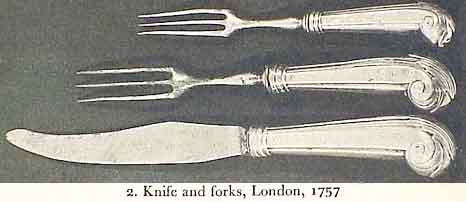
Kathryn Buhler, in Mount Vernon Silver, notes that George Washington's 1757 first purchase of silver included "2 Setts best Silver handle Knives & Forks best London Blades" from England. The forks were three pronged with their tines and the knife blades set in silver pistol shaped handles. She comments: ". . . these were a considerable luxury here when many even well-to-do householders were content to have their knives and forks with bone and even wooden handles." [This message has been edited by June Martin (edited 02-28-2009).] IP: Logged |
|
Scott Martin Forum Master Posts: 11520 |
posted 03-15-2006 05:13 PM
witzhall posted 03-15-2006 03:08 PM in the New Members' Forum; quote: IP: Logged |
|
outwest Posts: 390 |
posted 03-16-2006 12:17 AM
There are two days for presidents day holidays, not one: Lincoln and Washington. They are usually a week apart, but some celebrate them on a Friday and a Monday of the same week. IP: Logged |
|
ahwt Posts: 2334 |
posted 03-25-2006 11:16 PM
Swarter's comment about George Washington's silver is very interesting and I think these knives, forks and spoons are a good example of the kind of goods that Washington was accustomed to acquiring. Joseph J. Ellis in his book "His Excellency - George Washington" comments extensively on the many purchases that George Washington made through Cary & Company of London. Washington consigned the sale of his tobacco crops to Cary & Co. and it was this consignment or mercantile system that provided him easy access to London's shops. He could simply write Cary and order anything he desired and Cary would advance him the money. In the early 1760s Washington spent on average the equivalent of $400,000 to $600,000 per year with Cary & Co for the purchase of London goods. Washington discovered that in the long run that this system did not provide value to him as he came to the conclusion that too often he did not receive adequate payment for his tobacco crops and too often was overcharged for the goods from London. In his mind the system was designed to keep him in debt to Cary & Co. His reaction was to develop an independence from Cary & Co. by changing over the cash crop on his land from tobacco to wheat and developing his own distribution system to sell this wheat and limiting tobacco to lands from the Curtis family. Ellis points out that there is no direct evidence that Cary & Co. either underpaid Washington for the sale of the tobacco or overcharged for the goods Washington purchased. Rather it may be that this was the beginning of Washington's "rebellion against the slavish seductions of the British Empire." I suspect it was it was this same feeling that led Bostonians to rebel against the tax on tea and that it had little to do with the actual cost of the tea. Thanks to witzhall for discovering that President's Day has not legally replaced George Washington's birthday and to Outwest for noting the celebration of Lincoln's birthday in many areas. IP: Logged |
|
swarter Moderator Posts: 2920 |
posted 03-26-2006 04:50 PM
There is additional discussion of George Washington's silver in an earlier thread (Geroge Washington) by ahwt. IP: Logged |
|
witzhall Posts: 124 |
posted 04-24-2006 03:48 PM
Additional commentary on the development of forks appears in the latest Smithsonian magazine: May 2006, p. 34, in which the author suggests that forks were considered a European affectation until knives had become blunted and the Victorians and Americans began looking at every example as "the thing to do"! IP: Logged |
|
Dale Posts: 2132 |
posted 04-26-2006 12:23 AM
In Illinois, Presidents Day is about Lincoln, not Washington. In Missouri, there is a Jefferson day sometime in late spring. The reasons for President's day do vary. IP: Logged |
|
middletom Posts: 467 |
posted 04-26-2006 04:24 PM
In an article I read a couple years ago in the magazine "Silver", it was stated that Americans did not start becoming comfortable with the idea of silver forks until the 1830s. Forks, before then, were apparently of steel with either silver, bone or antler handles. Paul Rvere imported his from England. Elmer Senior, who founded ONC was referred toa as a "spoonman" in the incorporation papers, though that was in the early twentieth century and by then silver forks were a standard part of flatware production. I don't know if making a gfork was beyond the capabilities of most Colonial silversmiths, or if such a piece was just too exotic to be in demand. IP: Logged |
All times are ET | next newest topic | next oldest topic |
  |
|
Ultimate Bulletin Board 5.46a
|
1. Public Silver Forums (open Free membership) - anyone with a valid e-mail address may register. Once you have received your Silver Salon Forum password, and then if you abide by the Silver Salon Forum Guidelines, you may start a thread or post a reply in the New Members' Forum. New Members who show a continued willingness to participate, to completely read and abide by the Guidelines will be allowed to post to the Member Public Forums. 2. Private Silver Salon Forums (invitational or $ donation membership) - The Private Silver Salon Forums require registration and special authorization to view, search, start a thread or to post a reply. Special authorization can be obtained in one of several ways: by Invitation; Annual $ Donation; or via Special Limited Membership. For more details click here (under development). 3. Administrative/Special Private Forums (special membership required) - These forums are reserved for special subjects or administrative discussion. These forums are not open to the public and require special authorization to view or post. |
|
copyright © 1993 - 2022
SM Publications
All Rights Reserved. Legal & Privacy Notices |